Tashkent City Day Tour
Tour details
About the journey
Tashkent is Central Asia’s biggest metropolis — a city where ornate Islamic architecture, Soviet modernism and a young café culture live side by side. On this guided day tour you’ll see its greatest sights in one comfortable loop, travelling by air-conditioned coach.
Visit the Khazrat Imam Complex with the Kaffal Shashi Mausoleum, Barak Khan Madrasah and Tillya Sheikh Mosque, see the Islamic Civilization Center, browse Chorsu Bazaar — the city’s oldest market, ride the world-famous Tashkent Metro past its palatial stations, stop at the Monument of Courage and finish among the fountains of Independence Square and Amir Temur Square.
Not the city people expect
Most travellers arrive expecting a smaller, duller version of the Silk Road cities and find something else entirely: a large, green, modern capital with wide avenues and a serious café culture.
The reason is an earthquake in the last century that took most of the old fabric. What replaced it was Soviet planning at scale, and the result is a city of monumental public architecture rather than lanes.
What survived is concentrated rather than scattered, and it is remarkable. The Khazrat Imam complex holds one of the oldest Qurans in existence, and standing in front of it is not a small experience.
The city is also where contemporary Uzbekistan is most visible. If you want to know what the country is now rather than what it was, this is the day that tells you.
The metro
Built as public architecture rather than infrastructure, and each station designed on a theme — cosmonauts, poets, cotton. For decades photography in them was forbidden and they were largely unseen by visitors.
That restriction is gone, and the stations are now one of the best things in the city. They are ornate, well kept and entirely in use, full of people going to work under mosaic ceilings.
Riding a few stops is part of the day rather than an optional extra. It is also the fastest way to understand how the city thinks about itself.
The system is straightforward and clean, and the trains are frequent. Nobody needs to worry about navigating it — your guide handles that — but it is easy enough to use alone afterwards.
Khazrat Imam and Chorsu
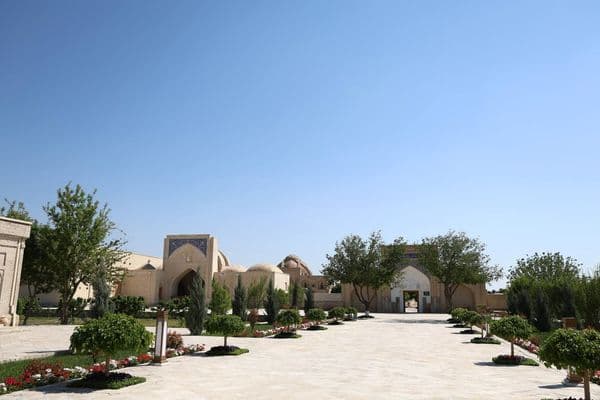
The Khazrat Imam complex is the religious heart of the city: the Kaffal Shashi mausoleum, the Barak Khan madrasah and the Tillya Sheikh mosque around a quiet square.
The library there holds manuscripts of real significance, and the atmosphere is markedly calmer than anywhere else on the day. It is a working religious site rather than a monument, and it behaves like one.
Chorsu is the opposite and the necessary counterweight: the oldest market in the city, under a great domed roof, loud and functioning and entirely uninterested in visitors.
The bread section alone justifies the stop. So does the fact that this is where the city actually shops, which is not something you can say about most of what a visitor sees.
What a guide adds here
More than in the older cities, oddly. Monuments explain themselves to some degree; a modern capital built over a lost one does not.
The gaps are the story in Tashkent — what stood where the squares are now, why the city looks the way it does, what the earthquake changed and what it did not. None of that is legible from the buildings alone.
A guide also solves the distances. The sights here are genuinely spread out, and a day spent working out how to get between them is a day mostly spent in transit.
And the food. Tashkent eats better than the rest of the country and almost none of that is findable without local knowledge on a first visit.
Who this suits
Travellers with a spare day at the start or end of a trip, which is the most common case and a good use of the time.
People arriving on a long-haul flight who want a gentle first day. This one is comfortable, largely seated between stops, and does not demand much.
Anyone curious about the country as it is now rather than only as it was. The capital answers that question and the historic cities do not.
It suits people whose interest is strictly medieval architecture rather less. If that is you, the day is better spent getting to Bukhara sooner, and we will say so.
Practical notes and season
Travel between sites is by vehicle with walking at each stop. It is one of the least demanding days in the catalogue physically.
The city is greener and shadier than anywhere else on our routes, and the tree cover makes summer here noticeably more bearable than in Samarkand or Khiva.
Modest dress at the Khazrat Imam complex. Elsewhere in the city no expectation applies at all — this is a capital and dresses like one.
Spring is the best season, when the city is in blossom and the parks are full. Autumn is close behind. Winter is grey and quiet, and the metro becomes the most appealing part of the day rather than a component of it.
Eating in the capital
The city eats better than anywhere else in the country, and by a clear margin. The variety comes from being a capital: regional cooking from across Uzbekistan arrives here and stays.
Plov is the obvious thing and it is genuinely worth planning around. Each region makes it differently, the capital argues about which version is correct, and the argument is worth listening to.
Beyond that there is Korean food from a community that has been here for generations, Uyghur noodles, Georgian bread, and a café culture that would not be out of place in Europe.
Lunch and dinner are both part of this day, which is unusual for a city tour and deliberate here. Eating is one of the things the capital does best, and skipping it would misrepresent the place.