Seven Pirs of Bukhara — Sufi Pilgrimage (4 Days)
Tour details
About the journey
This pilgrimage through the holy places of Bukhara is a deep spiritual journey into the living heritage of the Naqshbandi path. Its guiding philosophy: “Dil ba yoru, dast ba kor” — the heart with God, the hands at work.
Over four days you will visit all seven pirs — from Abdulkhaliq Ghijduvani to the great mausoleum of Khoja Bahauddin Naqshband — travelling in comfortable VIP minivans (Mercedes-Benz V-Class/Vito) with spring water, charging stations and natural aromatherapy on board, staying in authentic boutique hotels of the old town.
Two special evenings are spent at the “Ustoz-Shogird” art school of the world-renowned miniature master Davlat Toshev: conversations about the symbolism of traditional miniature and dinners of old Bukharan cuisine — including the legendary Osh-i Sofi plov cooked in copper cauldrons.
What a ziyarat is, and what it is not
Ziyarat is visiting for the sake of being near — near a person, near a place that person made holy, near a practice that has continued without interruption. It is not tourism with a religious theme attached.
The practical difference shows up in how the route is built. There is no pressure to keep moving, no ticking off, and no guide talking over a recitation. Where the tradition asks for silence, the programme allows silence.
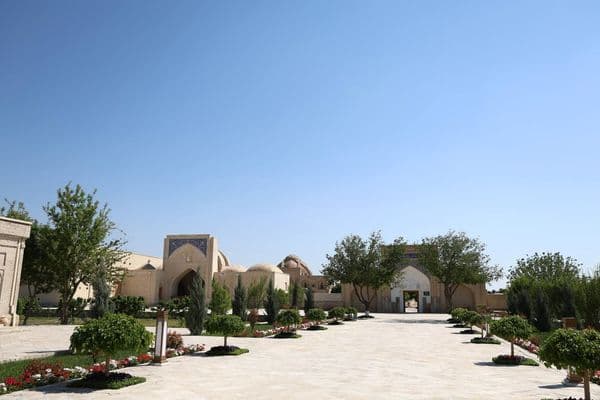
The shrines themselves are mostly modest. Travellers who arrive expecting the scale of the Registan are sometimes surprised by how plain these places are, and that plainness is the point — the significance is in who lies there, not in what was built above them.
We say all of this openly because a mismatch here is worse than a mismatch anywhere else in the catalogue. If what you want is Bukhara's architecture, we have routes for that, and they are better at it than this one is.
The chain of masters
The pilgrimage follows a lineage rather than a map. Each master taught the next, and the shrines are visited in that sequence, which is why the route doubles back on itself geographically in a way a sightseeing itinerary never would.
Abdulkhaliq Ghijduvani stands at the beginning of the chain, and Bahauddin Naqshband, whose name the path carries, stands at its centre. Between them are teachers whose names are known to practitioners and to almost nobody else.
The guiding maxim of the path — the heart with God, the hands at work — explains a great deal about why these places look the way they do. This was never a tradition of withdrawal, and the shrines sit among working villages rather than apart from them.
Understanding the sequence changes the experience considerably. We give you the lineage before the first visit rather than explaining it shrine by shrine, because arriving already knowing who you are visiting is the difference between a pilgrimage and a tour.
The rhythm of the route
Unhurried by design. Each shrine gets as long as it gets, and the schedule has slack built into it so that a longer stay somewhere does not compress everything after.
Mornings tend to belong to the shrines and evenings to Bukhara itself. That balance is deliberate: the old town at night, after the day visitors have gone, is a different and quieter place, and it suits the tenor of this trip.
The evenings at the miniature school are the one clearly cultural element. They sit well here because the art is devotional in origin — the symbolism being explained is the same symbolism carved into the shrines you visited that morning.
Travel between the shrines is in private vehicles rather than a coach, which matters less for comfort than for control: a group that wants to stay longer can stay longer without negotiating with a schedule shared by strangers.
What is asked of you
Modest dress at every shrine, for everyone. Covered shoulders and legs; a headscarf for women at the mausoleums. Guides carry spares, but arriving prepared is better than borrowing.
Shoes come off where the custom requires it, which is often. Footwear that comes off and goes back on easily makes the days considerably more pleasant than laces do.
Photography is restricted in places and forbidden in a few. The rule we ask travellers to follow is simple: if people are praying, the camera stays down, regardless of whether a sign says so.
Non-Muslim travellers are welcome at every site on this route and are not asked to participate in anything. What we do ask is that the visit be treated as a visit to a place of worship rather than to a monument, because that is what it is.
When to come
Spring and autumn are comfortable and the shrines are at their most pleasant, with gardens in use and courtyards worth sitting in.
Ramadan changes the character of the pilgrimage entirely. The shrines are busier, the atmosphere is more intense, and the practicalities of the day shift around fasting. Many pilgrims specifically want this; others find it demanding. We will talk it through rather than assume.
Fridays are busier everywhere and the Naqshband complex especially so. That is either the reason to come on a Friday or the reason to avoid one, depending entirely on what you are looking for.
Summer heat is real and the shrines have limited shade. Winter is quiet and cold, and the smaller sites can feel remote in a way that some pilgrims find suits them and others do not.
Who travels this route
Practitioners of the Naqshbandi path, most often — people for whom these names have been familiar for years and who are finally standing where the names are buried.
Family groups making the pilgrimage together, sometimes across three generations. The route accommodates this well; the pace is gentle and nothing on it requires particular fitness.
And a smaller number of travellers with a scholarly rather than devotional interest in Sufism. They are welcome, and the route works for them, provided the shrines are approached on the shrines' terms.
We do not run this as a fixed-departure group with strangers. Pilgrimage is not well served by that format, and the whole route is built around a party that already knows itself.