Bahauddin Naqshband Pilgrimage (2 Days)
Tour details
About the journey
Two days, one sacred purpose: the mausoleum of Khoja Bahauddin Naqshband, the great 14th-century master whose path still guides millions. The Afrosiyob high-speed train makes it an easy journey from Tashkent.
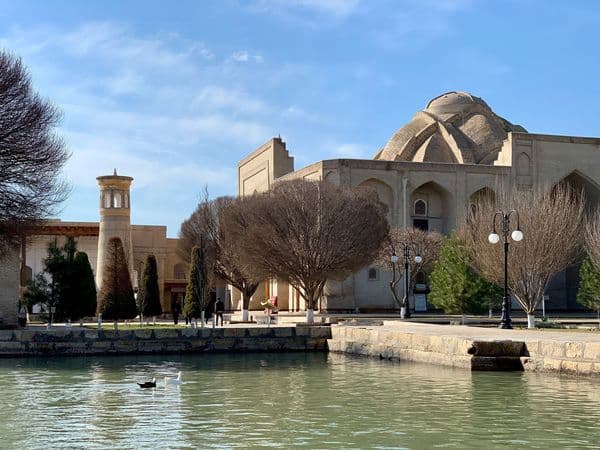
The first evening belongs to old Bukhara — Lyabi Hauz, the trading domes — and to a special night at the Ustoz-Shogird art school of miniature master Davlat Toshev: a conversation about the symbolism of Bukharan miniature, a hands-on master-class on silk paper and a festive dinner of Osh-i Sofi plov. The next morning is the quiet culmination: the memorial complex at Kasri Arifon with its mausoleum, sacred mulberry tree, mosques and gardens of contemplation.
What this route is for
One destination, approached properly. The complex at Kasri Arifon is the centre of the Naqshbandi tradition, and the route is arranged so that you reach it in a state to receive it rather than at the end of a rush.
That arrangement is the reason the visit falls in the morning rather than on arrival. Coming straight from a train to a shrine is possible and it is not the same thing.
It suits people already in the country on other business, travellers adding a pilgrimage to a wider trip, and anyone for whom the fuller route through all the masters is more than the calendar allows.
What it is not is a compressed version of the longer pilgrimage. It does not attempt the whole chain and does not pretend to. It does one thing, and it does that thing without hurry.
The memorial complex
The complex sits outside Bukhara among villages rather than in the old town, and the change of setting matters. You arrive somewhere that belongs to the people who live around it, not to the visitor economy.
Inside are the mausoleum itself, mosques, a garden and the mulberry tree that pilgrims have associated with the master for generations. People circle, sit, read and stay — often for far longer than a visitor would expect to.
It is a working shrine on every day of the week. You will be among people who came to pray rather than to look, and the visit is more rewarding if you let their pace set yours rather than the other way round.
The building is not architecturally spectacular by the standards of the city you just left. That comparison is the wrong one to make here, and we would rather set the expectation now than have it set badly at the gate.
Why the evening in Bukhara belongs here
Because arriving in the old town, walking it at dusk, and sleeping there is what puts you in the right frame for the morning. The alternative — arrive, sleep, visit, leave — is efficient and hollow.
The trading domes and Lyabi Hauz in the evening are also simply the best version of Bukhara. The heat has gone, the day groups have gone, and the old town returns to the people who live in it.
The evening at the miniature school is the other half of that. The symbolism being explained is devotional, and having it explained before the shrine visit rather than after gives you something to recognise in the morning.
The shared meal that ends the evening is deliberately a meal rather than a demonstration. It is how the hosts would receive a guest, which is a more honest introduction to the culture than a performance would be.
The train
The high-speed service makes this route possible at this length. Without it, the same pilgrimage would need considerably more time and most of that time would be spent on a road.
It is a comfortable, unremarkable way to travel, which is exactly what you want at the start of a pilgrimage. You arrive able to walk into the old town rather than needing to recover.
Seats on the popular departures go early, and this route depends on specific ones. That is the main reason we ask for dates as far ahead as you can give them.
If the seats we need are not available, we tell you and adjust rather than putting you on a long road transfer without saying so. The road version of this journey is a different trip and should be chosen deliberately if at all.
What is asked of you
Modest dress at the shrine: covered shoulders and legs, a headscarf for women. This applies from the gate rather than only inside the mausoleum.
Shoes come off in the prayer spaces. Slip-on footwear makes the visit easier and is worth choosing over anything that laces.
Photography is limited inside and inappropriate wherever people are praying. Nobody will stop you at every turn — the courtesy is expected rather than enforced, which is precisely why it matters.
Non-Muslim travellers are welcome and are not asked to take part in anything. Coming with the intention of being respectfully present is enough, and it is what the place is used to.
When to come
Fridays are the busiest at the complex, with a very different atmosphere: fuller, more communal, harder to find quiet in. Some pilgrims want exactly this and plan around it.
Ramadan raises the intensity everywhere and changes the shape of the day. It is a powerful time to make this visit and a demanding one, and we would rather discuss it with you than book it silently.
Spring and autumn are the most comfortable seasons for the garden and the walk through the complex, which is largely open to the sky.
Summer is hot with little shade at the shrine, and the evening in Bukhara becomes the more pleasant half of the trip. Winter is quiet, cold and unusually still — a version of this pilgrimage that suits people travelling alone.