Classic Uzbekistan — Tashkent, Khiva, Bukhara & Samarkand (8 Days)
Tour details
About the journey
This is the definitive Uzbekistan journey: Tashkent, Khiva, Bukhara and Samarkand in eight days, combining a domestic flight, a dramatic drive through the Kyzylkum Desert and high-speed trains.
Walk the walled museum-city of Ichan-Kala in Khiva, cross the desert along the Amu Darya to holy Bukhara, spend a full day among its trading domes and minarets with an optional folk show at Nodir Divan Begi, visit the emir’s summer palace, then finish in Samarkand — Registan, Gur-e-Amir, Shakhi Zinda — before an evening train back to the capital.
Who this route suits
It suits a first visit. Everything with a reputation is on it, and nothing on it is there to pad the schedule — each city earns its place by being unlike the others.
It also suits people who would rather not repack every morning. The route settles into each city long enough to walk it twice, once with a guide and once alone, which is when most of the country actually registers.
What it does not suit is a traveller who wants depth in one place. If Bukhara is the reason you are coming and the rest is optional, say so and we will build something narrower instead. This route is deliberately wide.
How the four cities differ
Tashkent is a working capital that happens to hold a remarkable collection of Islamic manuscripts and a metro built as public architecture. It reads as a modern city with old things in it, which surprises people who expected the reverse.
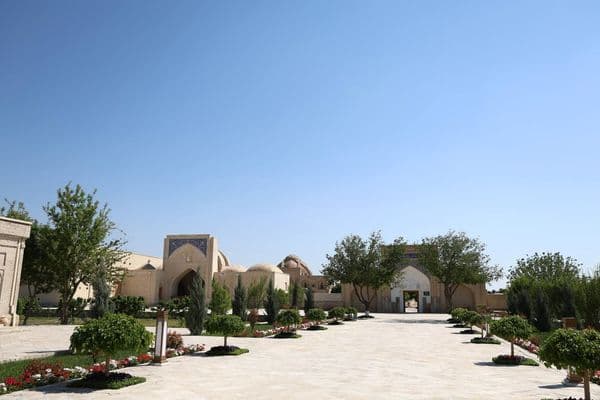
Khiva is the opposite: a walled town preserved whole, small enough to cross on foot and dense enough that you keep finding courtyards you missed. Its critics call it a museum. They are not entirely wrong, and it is still worth the flight.
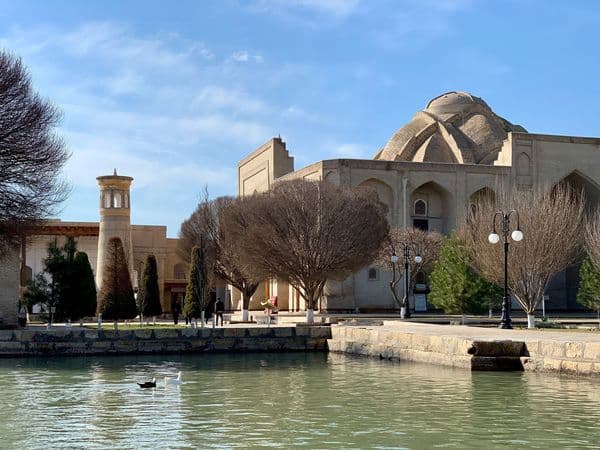
Bukhara is where most people stop arguing. The old town is lived in, the trading domes still trade, and the scale is human throughout. Samarkand is the reverse again — monumental, deliberately overwhelming, built by a ruler who wanted arriving envoys to feel small.
The desert crossing
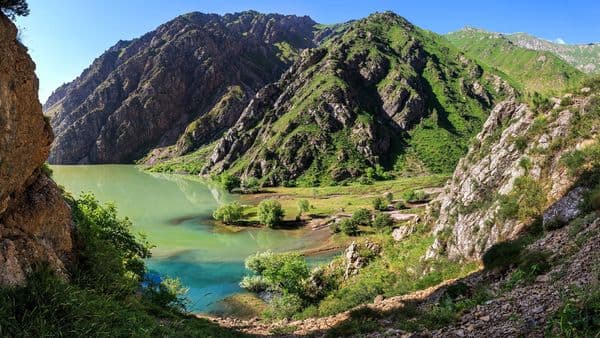
Between Khiva and Bukhara the route leaves the towns behind entirely and runs along the Amu Darya through the Kyzylkum. This is the part of the journey people remember without expecting to.
It is a long stretch in the vehicle, and we say that plainly rather than dressing it up. The landscape does not change quickly. What it does instead is make the distances between the Silk Road cities physical rather than theoretical — you arrive in Bukhara understanding why caravans mattered.
There are stops along the way: a teahouse, a view over the river, the point where the road and the water run together. None of them is a sight in the guidebook sense. They break the drive and they are the reason the drive is worth doing by road.
Trains and the flight
The high-speed trains between the eastern cities are genuinely good, and using them is not a compromise. They are comfortable, they run to schedule, and they turn what used to be an ordeal into a straightforward transfer with tea.
The flight to Khiva exists because the alternative overland is punishing. Flying preserves the day at the other end, which is where you want it.
One practical consequence: luggage moves with you rather than ahead of you, so what you bring is what you carry through stations. Travellers who pack light on this route are consistently happier than those who do not.
Seats are booked well ahead on the popular departures, which is one of the reasons we ask for dates early rather than close to travel. It is also why we would rather hold a route together than let it fragment into separate bookings made at different times.
If a rail seat cannot be had on the day the route needs it, we say so and rebuild around it rather than substituting a long road transfer without telling you. That substitution is common in this market and it changes the trip considerably.
When to come
Spring and autumn are the obvious answers and they are correct. The light is good, the courtyards are usable, and walking between monuments is a pleasure rather than an endurance test.
Summer is genuinely hot across the whole route, and the desert section is the hottest part of it. We will still run it, and people do enjoy it, but the day reorganises itself around the heat: early starts, a long middle indoors, and the sights again once the sun drops.
Winter is the least obvious and the most underrated. The cities empty out, the tilework looks extraordinary against a low sun, and you get the Registan close to alone. Bring more layers than you think and accept that some courtyards will be closed.
What people add
The most common addition is time in the Fergana Valley, east of the capital, where the craft workshops are and the tourism is thinner. It changes the character of the trip from monuments to making.
The second most common is a yurt camp near Aydarkul, which suits people travelling with children and anyone who wants a stay that is not a hotel.
People also extend inside the route rather than beyond it — more time in Bukhara is the request we get most often, and it is almost always the right one.
A smaller and cheaper adjustment is to stay on after the route ends rather than fly out the same day. The capital rewards an unhurried look, and arriving at the airport rested is worth more than most people expect.
What we advise against is adding Nukus and the Aral in the same run. It is a serious undertaking in its own right, the ground is hard, and stapling it onto a circuit that is already wide produces a trip nobody enjoys.
What to expect of the guiding
Guides are local to the cities they work in rather than travelling with you throughout. This is deliberate: someone who has spent a career on Bukhara will tell you things a national guide cannot.
The trade-off is that you meet new people through the route rather than building a relationship with one. Travellers who prefer continuity should say so and we will arrange it, though it means giving up some of the local depth.
Guiding is available in the languages we work in as standard. Less common languages exist in smaller numbers and are arranged per programme, which means the earlier a request arrives, the more likely it is to be met.