Majestic Triangle + Chimgan Mountains (7 Days)
Tour details
About the journey
All of the Majestic Triangle — Tashkent, Bukhara and Samarkand by high-speed train — plus a full day in the Chimgan Mountains: the Chinorkent cable car, panoramas of the western Tian Shan and the turquoise Charvak Reservoir.
Seven days, six hotel nights with breakfasts, local guides throughout, entrance fees and all rail tickets included. The ideal route if you want the Silk Road cities and a taste of Uzbekistan’s mountains in a single trip.
Why add mountains to a Silk Road trip
Because Uzbekistan is not only its cities, and a trip built entirely from monuments starts to blur. The western Tian Shan sits close enough to the capital to visit without restructuring the journey, and it resets the eye completely.
There is also a practical argument. Monument fatigue is real, and it usually arrives around the middle of a city-heavy route. Air and altitude in the middle send people back to the tilework able to look at it again.
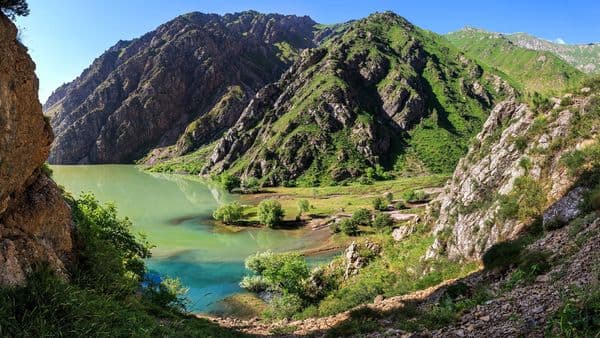
And the mountains are genuinely good. This is not a filler excursion. The ridgelines of the western Tian Shan are the real thing, and the reservoir below them is the colour people assume has been adjusted in photographs.
What the mountain day involves
The road climbs out of the capital through orchards and small settlements, and the change in landscape is abrupt enough to be startling. You leave a flat, hot city and arrive somewhere with different weather.
The cable car at Chinorkent carries you up to the viewpoints. It is not strenuous and it does not require any particular fitness — this is a day of looking rather than walking, unless you want it otherwise.
Charvak Reservoir sits below, turquoise against dry hills. In warm months people swim; in cold months the whole basin goes quiet and the views get sharper. Either version is worth the drive.
How this differs from the shorter circuit
The cities covered are the same three, and they are covered properly in both versions. Nobody is getting a thinner Bukhara here.
What changes is the rhythm. The shorter route moves city to city without pause; this one puts a gap in the middle, and the gap is what people remember. It also means arriving in Bukhara rested rather than accumulated.
Choose the shorter one if your time is fixed and the cities are the whole point. Choose this one if you have room and would rather not spend every day looking at architecture, however good the architecture is.
The trains between cities
The high-speed line linking the capital with Bukhara and Samarkand is the best piece of transport infrastructure in the country, and this route leans on it heavily.
This matters more than it sounds. It means the transfers are not lost time — you get tea, a window and a chance to sort photographs, and you arrive able to walk straight into a city rather than needing to recover from reaching it.
It also means the route is unusually gentle for the ground it covers. People who find long road days difficult do well here.
Season and the mountains
The mountain day changes character across the year far more than the city days do. In late spring the slopes are green and the water is high. In autumn the light is at its best and the air is sharp.
In summer the mountains are the relief on this route: while the cities are working through real heat, the plateau above the reservoir is noticeably cooler, and the day becomes the one people look forward to.
In winter there is snow up top and the cable car runs into a genuinely alpine scene. Bring proper layers — people underestimate this and regret it as soon as they step out at the top.
Practical notes
The mountain day is weather-dependent in the sense that visibility varies, not in the sense that it gets cancelled. Cloud sits on the ridges some mornings and lifts later more often than not.
Footwear matters more than clothing. The viewpoints involve uneven ground and loose stone, and sandals are a poor choice even in warm weather.
Everything else on this route is city walking on paved surfaces, so pack for two different kinds of day rather than one.
There is no altitude problem here in the medical sense. The viewpoints are high enough to change the air and the temperature, not high enough to change how you breathe, and nobody needs to acclimatise for this.
Food on the mountain day is simpler than in the cities — grilled meat, bread, tea, and not much choice beyond that. Tell us in advance about dietary requirements for this day specifically, because improvising up there is harder than improvising in Bukhara.
Who tends to choose it
Families, more often than not. The mountain day gives children something to do that is not looking at buildings, and the cable car is usually the part they talk about afterwards.
Photographers also gravitate to this version, because the mountains give them a subject the cities cannot: distance, weather, and light that changes while you watch it.
And returning visitors. People who have already done a city circuit somewhere in Central Asia often want the same cities done properly with something else attached, and this is that trip.
It is less suited to travellers whose interest is strictly historical. If your reason for coming is Timurid architecture and nothing else, the mountain day is a day you could have spent in Samarkand, and we would rather you knew that before booking.