Majestic Triangle — Tashkent, Bukhara & Samarkand (6 Days)
Tour details
About the journey
Tashkent, Bukhara and Samarkand form Uzbekistan’s “majestic triangle” — the essential first journey through the country. In six days you’ll ride high-speed trains between the three cities, sleep in comfortable centrally-located hotels and explore with local guides.
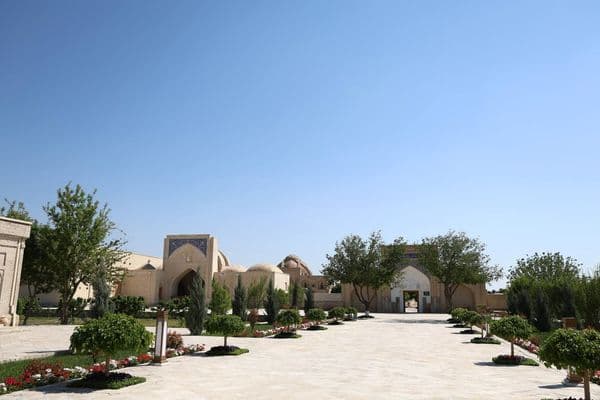
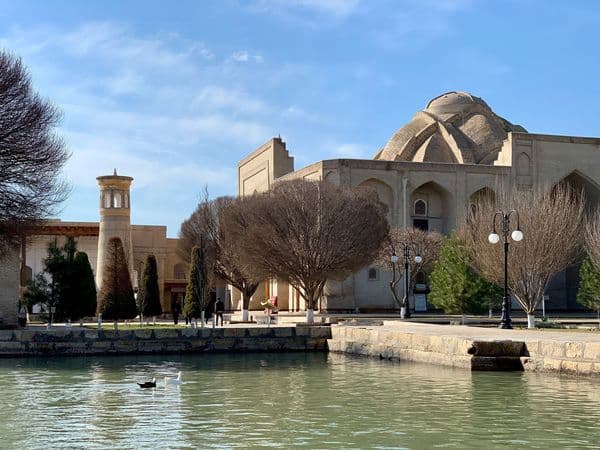
The route covers Bukhara’s old town from Lyabi Hauz to Poyi Kalon, the emir’s summer palace Sitorai Mokhi Khosa, Samarkand’s Registan, Gur-e-Amir and Shakhi Zinda, and a full day in the capital — from the Khazrat Imam Complex to the palatial metro stations.
What this route gives you
The three cities that most people picture when they picture Uzbekistan, each with enough time to see the main sites with a guide and then go back to whichever one caught you.
It is built around the rail line, which means the transfers are short and civilised and almost nothing is spent in transit. That is the whole reason the route works at this length.
It is also the easiest of our routes physically. There are no long road days, no early flights and no altitude. If mobility is a consideration for anyone in your party, this is the one to look at first.
What it leaves out, and whether that matters
Khiva is not on it. That is the honest cost of the shorter route, and we would rather say so here than have you discover it late.
Whether it matters depends on you. Khiva is extraordinary and it is also the hardest of the four cities to reach. Many people see the other three, decide the country deserves a second visit, and come back for Khiva and the west with more room.
The Fergana Valley, the desert and the mountains are also absent. Each is a separate trip in our catalogue, and each is better as a proper visit than as a rushed appendix to this one.
How the three cities read
The capital is where most people land and the place they are least prepared for. It is green, spread out and modern, with the country’s best museums and a metro worth riding for the stations alone.
Bukhara is the one that tends to become the favourite. The old town is compact, still inhabited and pleasant to be lost in. The trading domes are functioning markets rather than reconstructions.
Samarkand photographs best and takes the most adjusting to. Its monuments are enormous and set apart from each other, so the city reads as a series of set pieces rather than a fabric. Once you stop expecting Bukhara, it becomes remarkable.
The pace
Comfortable. The days have a guided portion and then a gap, and the gap is deliberate — it is where the trip stops being a tour.
The train departures set the shape of the travel days, and they are civilised departures rather than dawn ones. Nobody is dragged out of bed on this route.
That said, city sightseeing is walking, and the sites are large. People who walk comfortably at home walk comfortably here; people who do not should tell us in advance so we can adjust the ground covered rather than the number of sites.
When to travel
The shoulder seasons are best and they are also busiest, which is a real trade-off rather than a formality. The Registan at peak season has crowds.
Summer heat is significant in all three cities and there is no mountain day here to escape into. It is manageable with an adjusted schedule, and it is the season when the country is quietest, which some travellers weigh heavily.
Winter is cold and clear, the sites are nearly empty, and photographs from that season are the ones people are surprised by. Some monuments have reduced access, and we will tell you which before you commit.
Making it longer
The single most useful addition is a mountain day near the capital, which is why we run that combination as its own route rather than as an add-on.
The second is time rather than places — more room in Bukhara, or a slower start in the capital to shake off the flight.
If you have real space, the better move is not to stretch this route but to choose the wider one that includes Khiva and the desert. Stretching a short circuit rarely produces the trip that a longer circuit produces.
The one addition that works without changing the shape is an evening: a folk performance in Bukhara, or dinner somewhere that is not a hotel restaurant. Small, and it tends to be what people describe when they get home.
Arriving and leaving
Most international arrivals land in the capital, and most land at an unsociable point of the night. This is a fact of the route rather than a fault of it, and the schedule allows for it — nothing demanding is asked of you on arrival day.
Transfers are ours from the moment you clear the terminal. You will not be looking for a name board among a crowd of drivers, which is the part of arriving in an unfamiliar country that people dread most.
Departure works the same way in reverse. If your flight leaves late and the room has to be given up, we hold luggage and arrange somewhere to be, rather than leaving you with an afternoon and nowhere to spend it.
Visa arrangements are outside what we handle, but we will tell you plainly what applies to your passport rather than pointing you at a page. Getting that wrong is the single most expensive mistake a traveller can make before departure.