
Food & Crafts
Plov, bazaars, silk weavers and blue ceramics.
Let us be straight about this one. We do not sell a packaged food tour of Uzbekistan, and you will not find one listed below. What we do is build food-led trips to order, and this page exists to say what that involves rather than to pretend a product exists.
The reason is simple. A good food trip depends on who is cooking that week, which bazaar is at its best that month, and which workshop will let strangers watch. None of that survives being printed as a fixed itinerary a year in advance.
What there is to eat and see
Bread first. Every region bakes it differently and Samarkand argues with the rest of the country about whose is best. Then plov, which changes from city to city — layered in Samarkand, stirred and richer in Tashkent — and which has a building dedicated to it in the capital.
Beyond that: Khorezm noodles kneaded green with dill, dumplings filled with egg and butter, kebabs over vine cuttings, halva sold by the slab, and the fruit, which in season is the best argument for coming at all. Melons, apricots, grapes and pomegranates arrive in a sequence the whole country pays attention to.
The tea deserves its own sentence. It is green, drunk hot regardless of the weather, and the bowl is deliberately filled only part way — a brimming bowl is a polite hint that the guest should be leaving. Refusing tea altogether is close to impossible and should not be attempted.
Craft, which is the other half
Food and craft belong together on a trip like this because they are made in the same places by the same kind of hands. Margilan weaves silk the way it has for centuries, binding and dyeing the warp so the pattern exists in the threads before a single one is woven. Rishtan throws and glazes pottery from clay under the town.
Around them: suzani embroidery, metal chasing in Bukhara, wood carving in Khiva, and paper made from mulberry bark outside Samarkand. Workshops are generally open to visitors and generally happy to be watched, which is not true everywhere in the world.
What makes these crafts worth a trip rather than a shopping stop is that almost none of them were revived for tourism. They were working industries through the last century, supplying a domestic market, and they came out of it with the knowledge intact. Elsewhere in the region the old techniques had to be reconstructed from museum pieces; here they were simply never stopped.
What a trip like this looks like
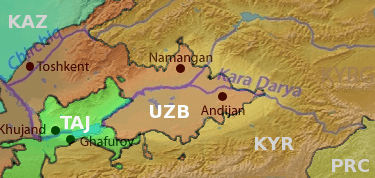
Usually it is a normal route through the cities with the emphasis moved. Fewer monuments, more bazaars. A morning with a family cooking rather than an afternoon in a museum. A detour into the Fergana Valley, which is where most of the craft actually happens and which standard itineraries skip.
Practically it needs more advance work than a standard trip, because the good parts depend on people rather than opening hours. Give us a few weeks rather than a few days, and tell us whether you want to cook or only to watch — that single answer changes most of the plan.
One thing worth knowing: the best meals on a trip like this are usually in houses rather than restaurants. Uzbek restaurant cooking is decent and repetitive; home cooking is where the range is. Arranging that takes introductions, and introductions are most of what we are actually providing when someone asks for a food trip.
When to go
Late summer and autumn if the fruit is the point, because that is when the bazaars are at their fullest and the melons are what people travel for. Spring if you want blossom, green valleys and the first vegetables rather than the harvest.
Winter is the quiet season and it suits craft better than food: the workshops keep working, the bazaars shrink, and you get people’s full attention because nobody else is there. High summer is hard on the road but excellent in the markets, if you can handle the heat between them.
Ramadan is worth checking against your dates. Daytime eating is restrained in a way that changes a food trip substantially, and many places that would normally feed you at midday do not. The evenings, on the other hand, are extraordinary. Whether that makes it a good time or a bad one depends entirely on what you came for, and we will tell you which we think it is.
Dietary needs, honestly
Uzbek cooking is built on lamb, beef and dairy. Vegetarians eat well enough — bread, salads, vegetable stews, dumplings, and the fruit — but it takes planning and a guide who will ask the right questions rather than assume. Vegans have a harder time and should tell us early.
Halal is the default across the country and needs no arranging. Serious allergies do need arranging, and need saying at the point of enquiry rather than at the table. We would rather over-communicate this than have someone eat something they should not.
How to start
Write and tell us three things: roughly when, roughly how long, and what draws you — the cooking, the crafts, the markets, or all of it. A rough budget helps more than people expect, because it decides whether the answer is a homestay in a village or a restored merchant house in Bukhara.
We will come back with a proposed route and a price rather than a brochure. If what you want turns out to be something we cannot do well, we will say so instead of selling you an approximation of it.
Built to order
We do not sell this as a packaged tour. Tell us what you have in mind and we will put together an itinerary, quote it, and run it ourselves.