
Termez
A first look
Termez is the far south, on the bank of the Amu Darya with Afghanistan on the other side, and it is unlike anywhere else in the country. This is the one place where the deep past is not Islamic but Buddhist and Greek, and where ruins in the desert predate everything on the standard route by a very long margin.
It is also the least visited of the historic cities, partly because it sits at the end of a long road and partly because these ruins ask more of a visitor than tiled domes do. If you like your history reconstructed, this is not the stop. If you like standing in a place and working out what happened there, it may be the best one.
What to see
The southern edge
The Amu Darya has always been the boundary here, and Termez has always been the crossing. Alexander came through, and the region afterwards was governed by Greek-speaking kings who minted their own coins and laid out cities on a Hellenistic plan. What followed was the Kushan empire, which took Buddhism from India and pushed it north through exactly this corridor.
That makes the district a layer cake unlike any other in Central Asia — Greek, Buddhist, Zoroastrian and finally Islamic, each on top of the last, and much of it still in the ground. The heat, the emptiness and the closeness of the border all contribute to the sense of standing at the edge of things.
Practically, this is a border town and it behaves like one. Documents get checked more often than elsewhere in the country, parts of the riverbank are off limits, and a guide who knows which sites are currently open saves a great deal of driving. None of that makes the place difficult, but Termez does reward a little planning in a way that Samarkand never asks for.
Before Islam
Kara-Tepa and Fayaz-Tepa are the reason serious travellers come. They are Buddhist monastery complexes in bare desert: courtyards, cells cut into the rock, and a stupa reconstructed enough to read as a stupa. The famous sculptures found here are in museums now, but the plans are legible on the ground and the setting does the rest.
Standing in a monk’s cell above the Amu Darya with nothing green in sight changes how you think about the geography of Buddhism. This was not a fringe outpost; it was on the main road. The archaeological museum in town holds the finds and is worth visiting before or after, because it supplies the objects the sites are missing.
The Islamic layer
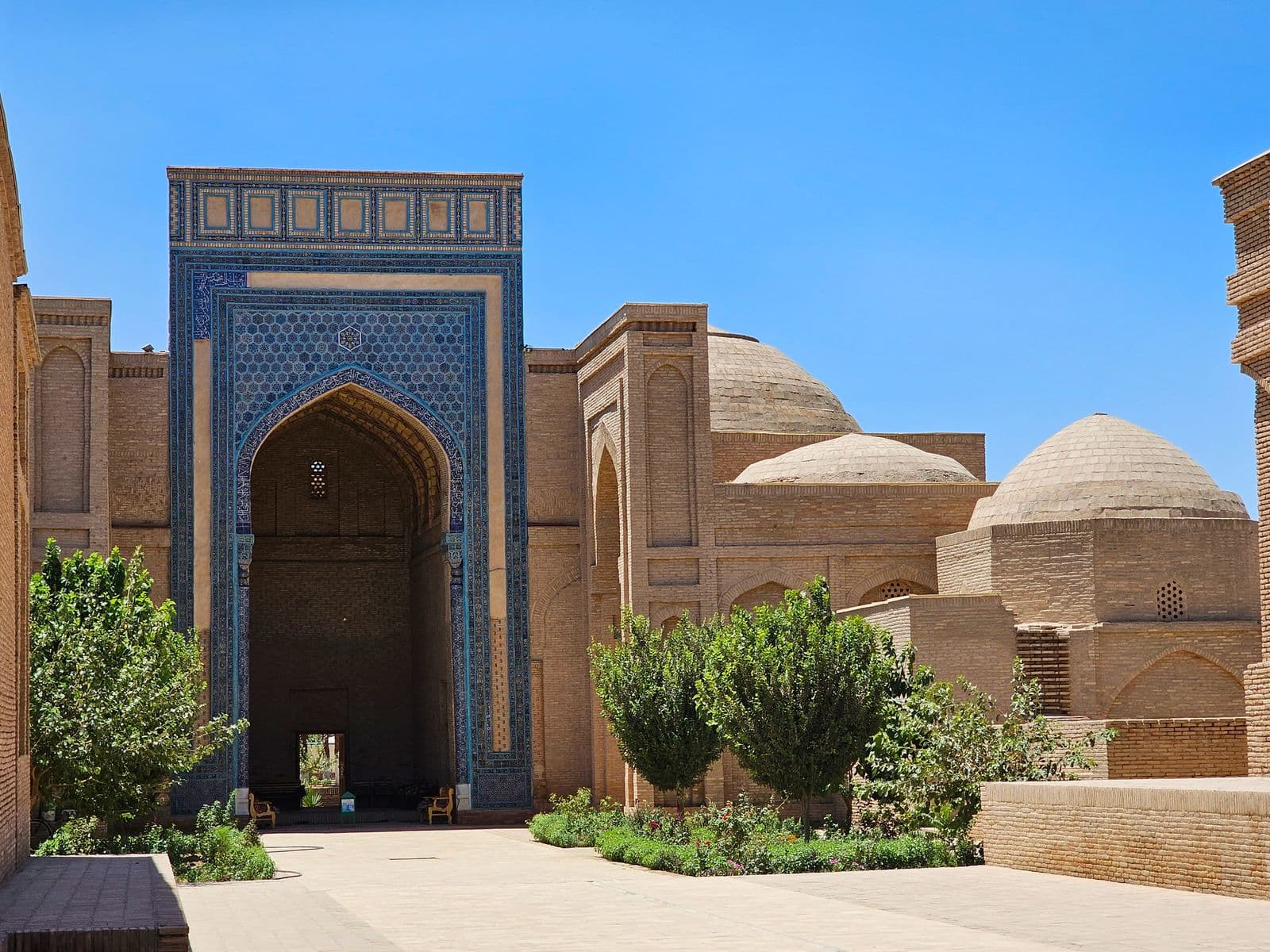
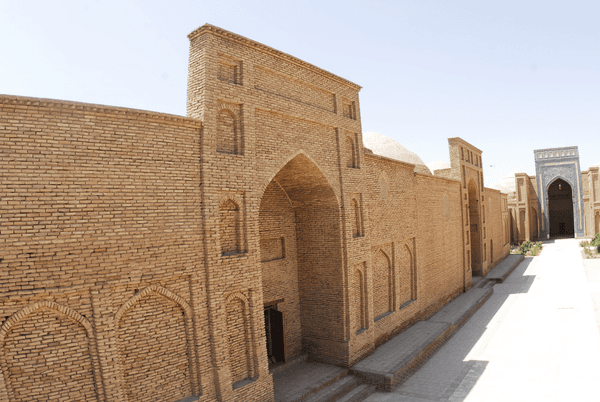
Sultan Saodat is the finest thing in Termez and almost nobody sees it: a long courtyard of mausoleums raised over several centuries for a line of sayyids, faced in figured brick rather than tile. The effect is quieter than the great ensembles further north and, to some eyes, better — pattern made out of the structure itself instead of applied to it.
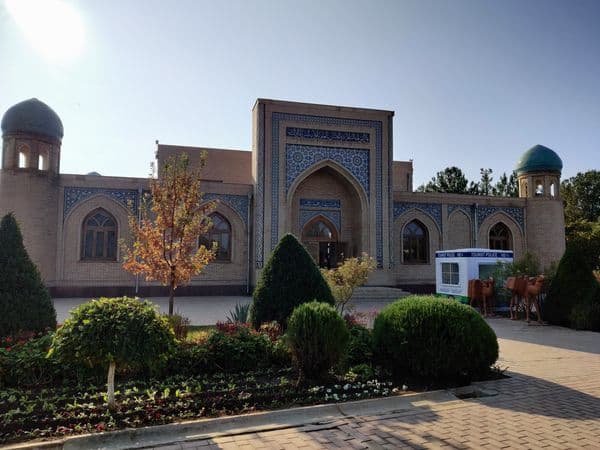
The Hakim at-Termezi complex sits on the riverbank and is a working pilgrimage site rather than a monument, dedicated to a Sufi writer of great standing. It is the busiest place in the district at the end of the week, and the contrast with the empty Buddhist hills a short drive away tells the whole story of the region in one afternoon.
Kirk-Kyz and the open ground
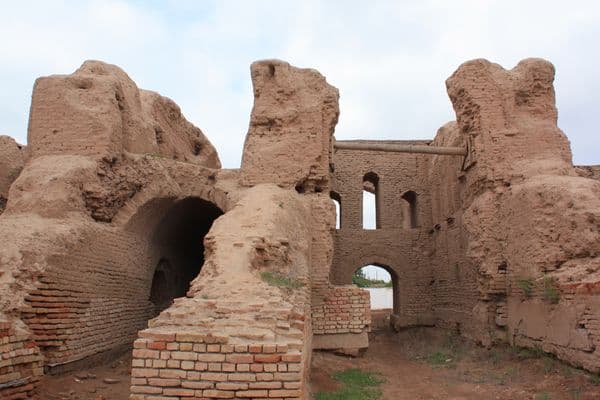
Kirk-Kyz, the Forty Girls, is a square brick building alone on flat ground, roofless now, with vaulted chambers arranged around a cross-shaped core. Nobody is certain what it was — a country residence, a caravanserai, a fortified retreat. The name comes from a legend about a garrison of women, the kind of story that attaches itself to buildings whose purpose has been forgotten.
Around it the steppe holds more sites than anyone has excavated. Some are fenced, some are a mound and a sign, some are neither. This is a district for people content to look at a low ridge and be told that it is a city.
When to come
Termez is the hottest place in Uzbekistan, and high summer is simply not workable for sightseeing: the sites are unshaded, the ground throws the heat back, and there is nowhere to retreat to. Plan around it rather than through it.
Spring is the season — mild, briefly green, with the desert sites at their most walkable. Autumn works too, from the point the heat breaks. Winter is mild by national standards, sometimes damp, and perfectly comfortable for walking ruins, which makes it an underrated option for this particular city.
Where it fits in a route
Termez is a deliberate detour, not a stop on the way to anywhere. Flying from Tashkent is what most people do; the railway also runs down and takes the best part of a day and a night. Either way the city is the end of the line, and you return the way you came.
Give it two nights if you can. One is enough to see the main sites and not enough to understand any of them, and the museum plus the Buddhist hills plus Sultan Saodat is a great deal to compress. Travellers combining it with Baysun or the Sangardak waterfall to the north-east can make a loop of the whole south.
No payment now. We reply with a tailored plan within a few hours.