
Shakhrisabz
A first look
Shakhrisabz is the town Timur came from, and the one place where you can see what he built for himself rather than for an audience. The name means green town, and it is earned: orchards and irrigation channels under the shoulder of the mountains, cooler and slower than Samarkand on the other side of the pass.
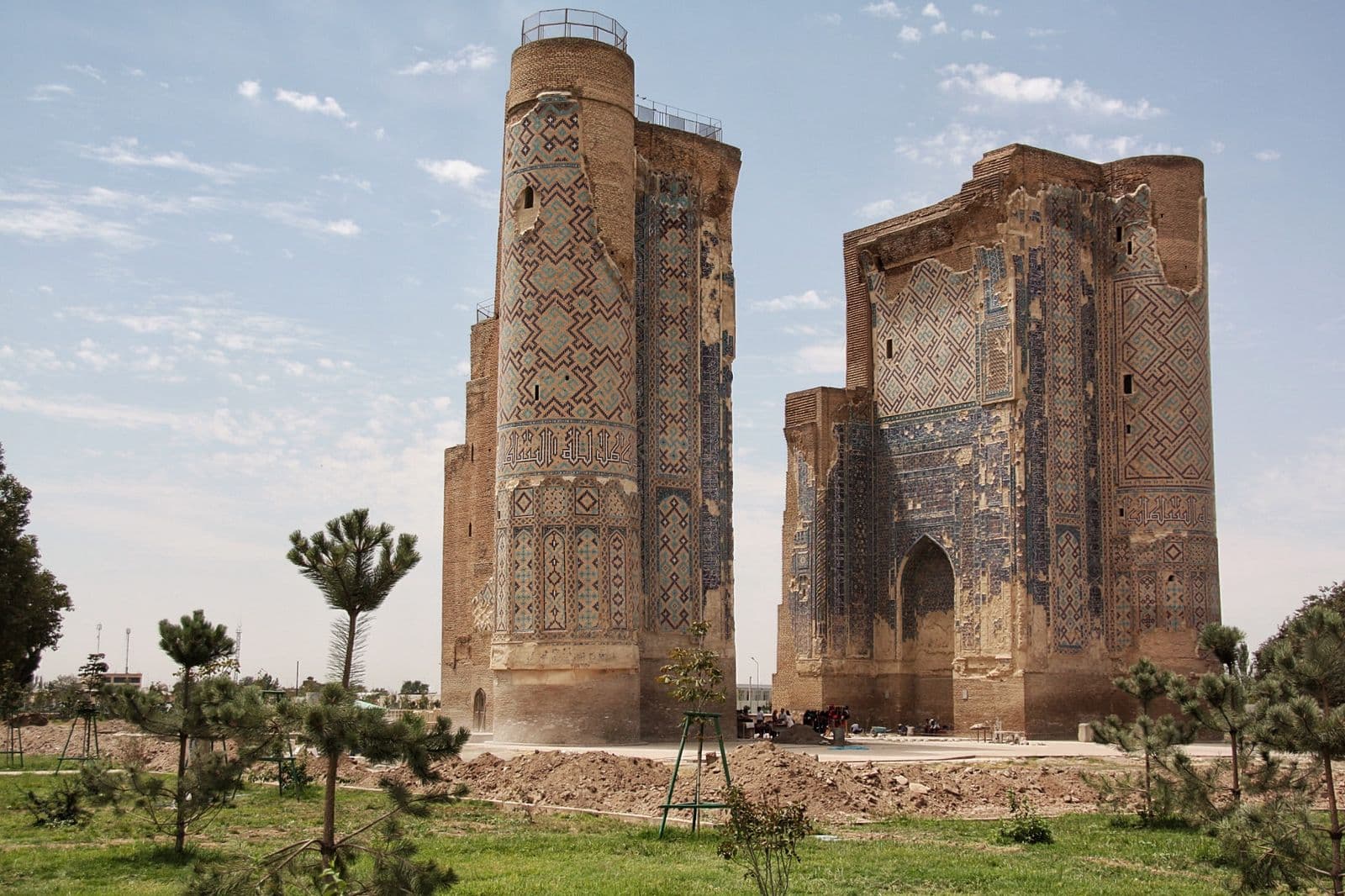
What survives is fragmentary, and that turns out to be the point. The palace is a pair of towers with nothing between them, and the gap tells you more about the scale of the original than a complete building ever could.
What to see
The town he came from
Timur was born in this district, into a minor clan, and he never treated the place as provincial. Once he had an empire he set about turning his home town into its second capital — not an administrative one, but a dynastic showpiece: the town his family would be buried in and remembered from.
That project ran for decades and used the same imported craftsmen who worked on Samarkand. Later rulers had other priorities and the town declined, which is why the monuments here stand in gardens rather than in a dense old city. The centre has since been cleared into parkland, a decision still argued about — it makes the ruins easy to see and strips them of the streets they once stood in.
What is left of Ak-Saray
The White Palace was the largest thing Timur ever built, and what remains are the two flanking towers of its entrance arch, standing apart with sky between them. The arch itself is gone. Walk up to the base and the tilework is still there in places — deep blue, turquoise and white, laid in bands of geometric and script ornament running higher than the eye can follow.
The inscription on the surviving pier is famous for its confidence: it invites anyone who doubts the power of the builder to look at what he made. It is worth standing in the gap between the towers long enough to work out how wide the original opening was. Nothing else in the country gives that sense of interrupted scale.
Kok-Gumbaz and the tombs
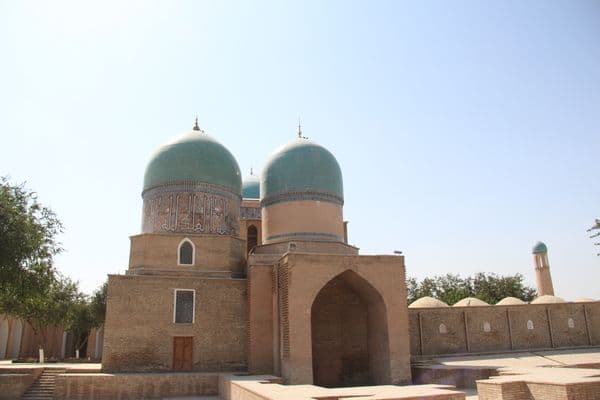
South of the palace the older part of town keeps a cluster of buildings that survived because they were religious rather than imperial. The Dorut Tilavat complex holds the Kok-Gumbaz mosque, whose blue dome is more restrained than anything in Samarkand and better for it, along with the mausoleums of the clergy who served the dynasty.
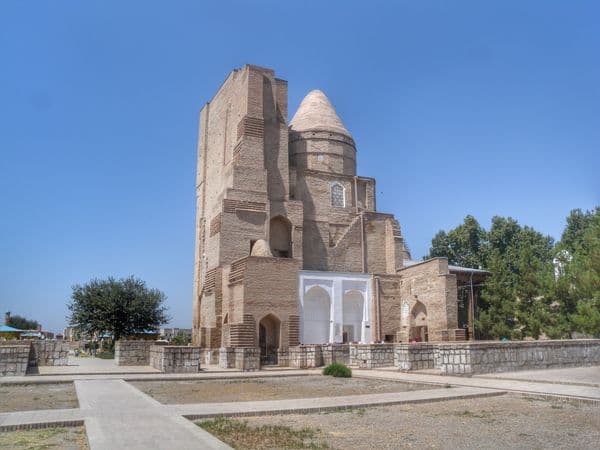
Nearby is the Dorus Siadat memorial, the intended burial complex of Timur’s line, where a crypt was found beneath the floor with a stone sarcophagus prepared and never used — he was buried in Samarkand instead. Standing in that empty crypt is the strangest part of a visit to Shakhrisabz, and the part people remember.
Between the monuments the working town carries on, and it is worth stepping off the park paths to find it. The bazaar lies a short walk east and trades in the produce of the surrounding orchards rather than in souvenirs, and the tea houses around it fill up in the middle of the day. Shakhrisabz has fewer visitors than its monuments deserve, which means nobody is selling to you, and that changes the tone of a visit.
The road over the pass
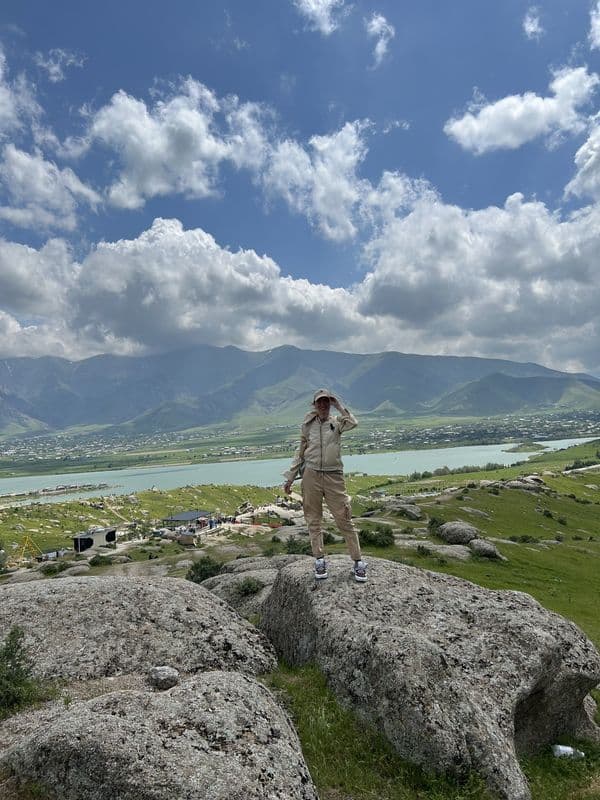
Most people arrive from Samarkand, and the journey is half the reason to come. The road climbs the range to the Takhtakaracha pass and the landscape changes completely on the way up: irrigated fields give way to bare rock and then to high pasture, with switchbacks and long views back over the valley.
At the top a line of roadside kitchens serves meat baked in clay ovens, which is the traditional stop and worth making. On the far side the descent is greener than the climb, and Shakhrisabz appears in a bowl of orchards. In winter the pass can close in bad weather and traffic goes the long way round instead, which adds to the journey.
When to come
Spring is exceptional here. The town lives up to its name — blossom in the orchards, water running in the channels, snow still visible on the ridge above. Autumn is dry and clear, and the light on the towers is at its best in the second half of the day.
Summer is hot but noticeably easier than the plain, because the altitude and the gardens do some of the work. Winter is cold and often grey, and the parkland around the monuments looks bleak, though the ruins themselves gain something from an empty sky. In the cold months the pass is the thing to check before setting out.
Where it fits in a route
Shakhrisabz is the standard day trip from Samarkand and works well as one — the monuments sit close together and the visit is not long. A slower option is to come over the pass, stay the night and continue south the next day, which puts you within reach of the road towards Termez.
Whichever way you do it, do not treat it as an optional extra. Samarkand shows what Timur built to impress the world; this shows what he built for himself, and the two make more sense together than either does alone.
No payment now. We reply with a tailored plan within a few hours.