
Navoi & Sarmyshsay Gorge
A first look
Sarmyshsay is a gorge in the hills north-east of Navoi where the rock faces are covered in prehistoric carvings, and it is one of the great concentrations of rock art anywhere in Central Asia. Navoi itself is a modern industrial city and mostly a base — but the district around it holds more than the gorge.
Between the petroglyphs, a ruined Silk Road caravanserai and an underground reservoir the size of a small building, this is a stop for people interested in how humans have used a dry landscape over a very long period.
What to see
A gallery cut into stone
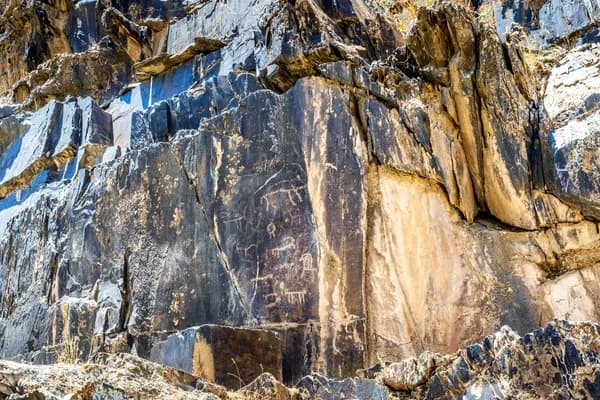
The gorge cuts back into the Karatau hills, with a stream running along the bottom and dark, varnished rock faces on both sides. Those faces are the canvas. Figures are pecked and scratched through the dark surface layer into the lighter stone beneath, which is why they still read clearly after so long.
The carvings are not from one period. The oldest belong to the Stone Age and show wild animals and hunters at a scale that suggests the animals mattered more than the people; later layers add domesticated stock, riders, carts and eventually inscriptions. Walking up the gorge is walking forward through that sequence, if you know what to look for.
Reading the rock
Bulls with exaggerated horns, ibex, deer, dogs, and human figures with bows and raised arms make up most of what you will see. Some panels are clearly compositions — a hunt, a procession, a ritual — and some are single figures added centuries apart on the same face.
You will find them faster with a guide and slower but more rewardingly on your own. The trick is to stop looking for pictures and start looking for the dark polished surfaces, because that is where the carvings are. Once your eye adjusts, the gorge stops being empty rock and becomes crowded.
The carvings are fragile in a way that is easy to forget, because they are outdoors and unguarded. The dark surface they are cut through takes an extremely long time to form, and a chalk outline, a scratched initial or a wet rubbing damages a panel permanently. Look, photograph in raking light, and touch nothing — there are no staff here to prevent any of it, which makes the responsibility entirely yours.
The gorge holds more than the art. There is a stream with pools in the upper section, wild pistachio and almond on the slopes, and enough birdlife to keep anyone with binoculars occupied. Families from Navoi come out at weekends for exactly those reasons rather than for the petroglyphs, which is a useful reminder that this is a landscape people use rather than a monument they visit.
Rabat-i Malik and the road
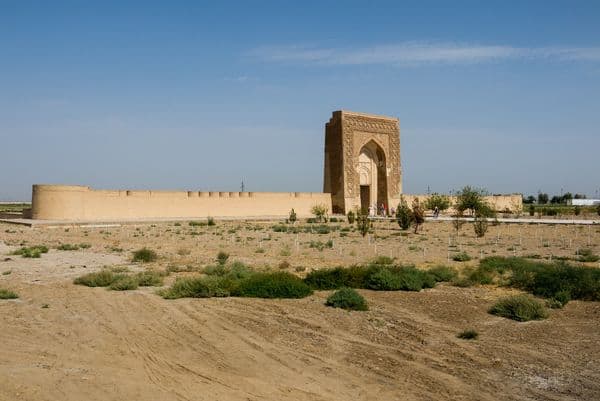
Out on the plain between Navoi and Bukhara stands the surviving portal of Rabat-i Malik, a fortified caravanserai from the Karakhanid period. Only a fragment is left — a monumental entrance and traces of the enclosure — but the fragment is enough to show what it was: a defensible stop for caravans on an exposed stretch of road.
The corrugated brick of the facade is the detail to look at. It is a technique that predates the great tile traditions and depends entirely on how brick is laid and how the sun falls across it, which means the building looks different at each end of the day.
Water and the memorial ensemble
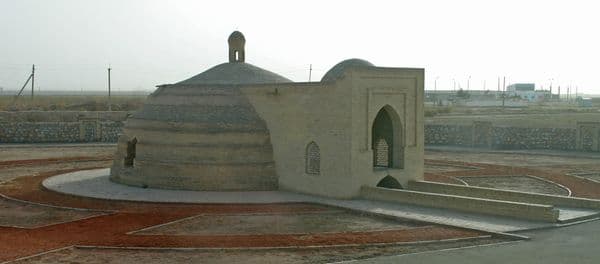
Opposite the caravanserai is Malik Sardoba, a domed underground cistern of unusual size, built to serve the same traffic. Steps lead down to the water level and the temperature drops as you descend. Together the two buildings are the clearest surviving illustration anywhere of how a Silk Road stage actually worked: shelter, defence and water in one place.
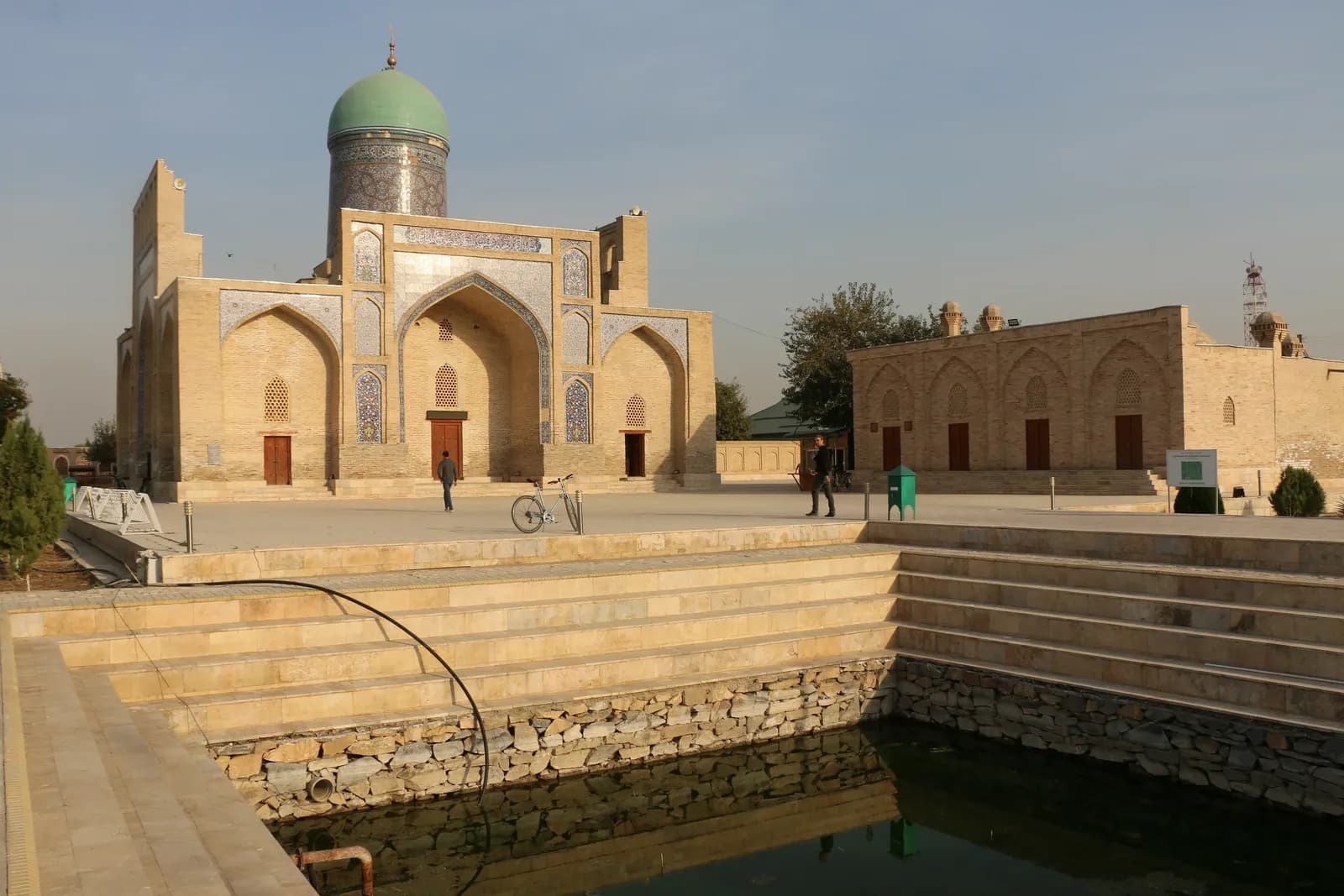
Nearer to Navoi, at Karmana, the Kasym-Sheikh ensemble is a memorial complex around the tomb of a Sufi sheikh, with a khanaka and later additions. It is a working shrine rather than a monument, quiet on most days, and it rounds out a district that otherwise reads as purely archaeological.
When to come
Spring is much the best season: the gorge has water in it, the hills are briefly green, and there are wildflowers on the slopes. Autumn works well too, dry and clear with comfortable walking temperatures.
Summer is hard. The gorge is a stone trap for heat and the walk is longer than it looks. Winter is cold and can be snowy at this altitude, but the low-angle light is the best of the year for seeing carvings, which is why photographers come then despite the conditions.
Where it fits in a route
Navoi sits on the main road and railway between Samarkand and Bukhara, which makes this district the natural way to break that leg. The gorge takes half a day including the walk; Rabat-i Malik and the sardoba are a short stop on the road itself.
It combines well with Nurata and Aydarkul, which lie to the north-east, and a common pattern is Samarkand, a night at the lake, the petroglyphs the next morning and Bukhara by evening. That turns two transfer days into a proper part of the trip.
No payment now. We reply with a tailored plan within a few hours.