
Margilan & Rishtan
A first look
Margilan and Rishtan sit close together in the Fergana Valley, and between them they account for most of what Uzbekistan still makes by hand. One weaves silk, the other throws pots, and both have been at it long enough that the technique is the point rather than the product.
Neither town is beautiful the way Bukhara is beautiful. You come here for workshops rather than monuments — and for the fact that in both places the person making the thing will stop and show you how, because visitors are still uncommon enough to be interesting.
What to see
Two towns, two crafts
Margilan has been a silk town since the trade road ran through it, and the craft survived every attempt to industrialise it because the pattern cannot be made any other way. Rishtan, further west, sits on a seam of clay and has thrown and glazed pottery for as long as anyone has recorded.
What links them is that neither craft was ever revived for tourists. Both were working industries through the last century, supplying the domestic market, and both came out of it with the knowledge intact. That is unusual: in most of the region the old techniques had to be reconstructed from museum pieces, whereas here they were simply never stopped.
How khan-atlas is made
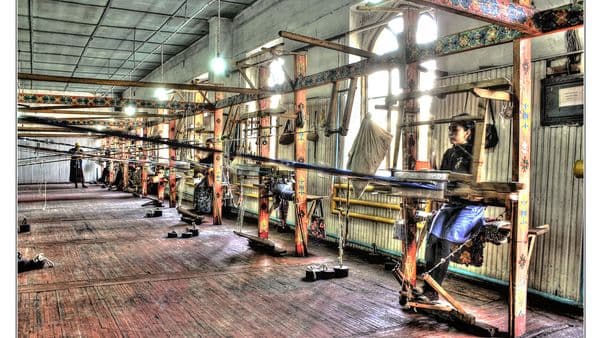
The silk arrives as cocoons and leaves as cloth, and every stage in between happens in the same set of buildings. Cocoons are boiled to loosen the gum, the filament is reeled off by hand onto a frame, and the thread is twisted and washed until it will take dye evenly.
Then comes the part that makes ikat ikat. The warp threads are stretched, grouped into bundles and tied off tightly wherever the pattern requires them to stay undyed. The bundle goes into the dye bath, the ties are moved, and it goes in again for the next colour. By the time the warp is unwrapped and set on the loom, the whole design already exists in the threads, very slightly out of register — which is exactly what gives the finished cloth its soft bleeding edges.
The bazaar and what to buy
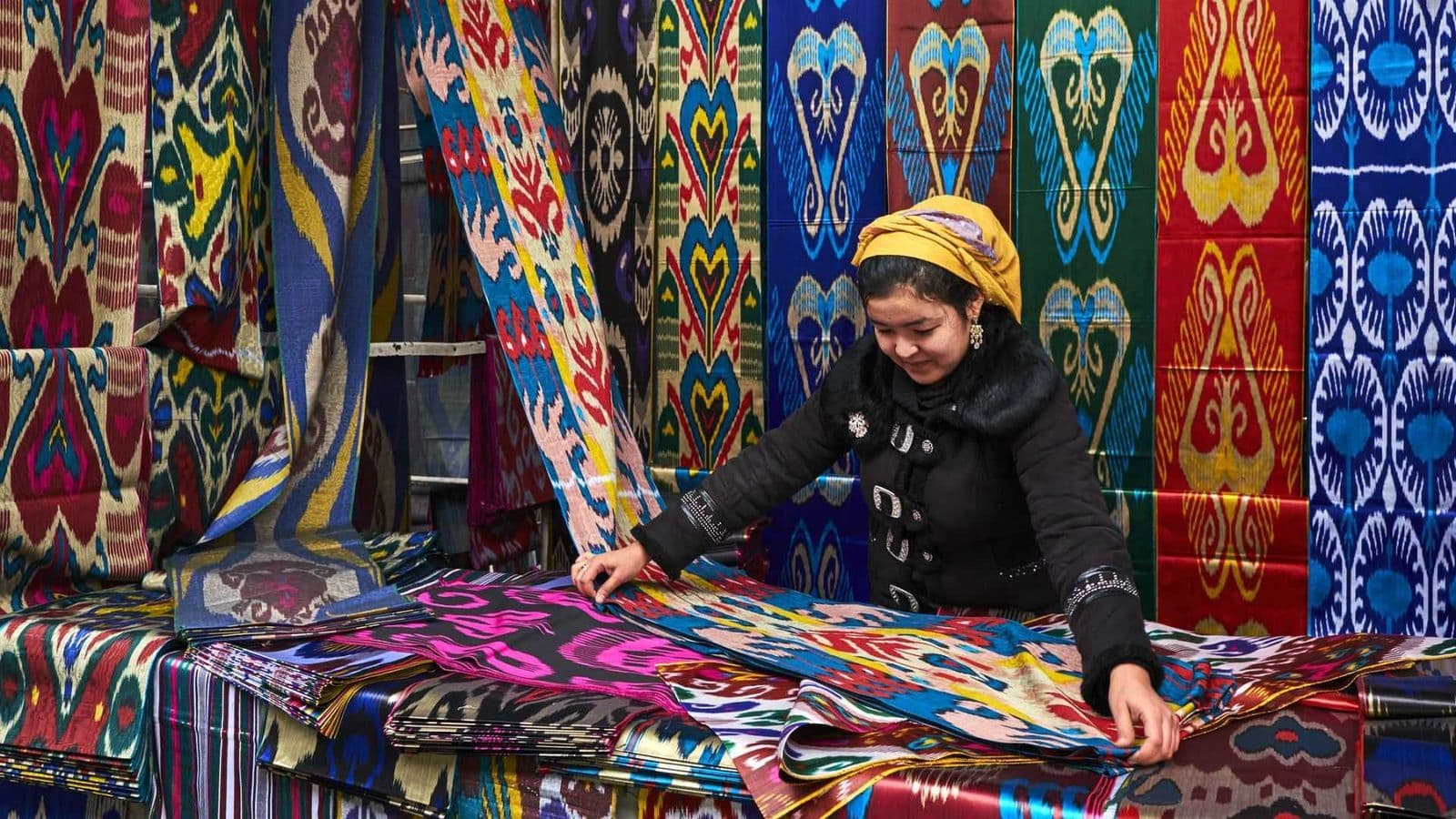
The silk bazaar in Margilan is the other half of the visit. Rolls of atlas and adras are stacked to the ceiling in every colour combination the dyers have thought of, and the difference between the two matters: atlas is pure silk and drapes, adras has a cotton weft and holds its shape.
Machine-printed imitation exists and is sold openly at a fraction of the price. Ask, and you will be told which is which — sellers here are not coy about it. Handle both and the difference is obvious: hand-dyed ikat has slightly uneven pattern edges and a weight that printed cloth never has. Buy from the bolt rather than pre-cut, and buy where you watched it being made if you can.
Rishtan and the ishkor glaze
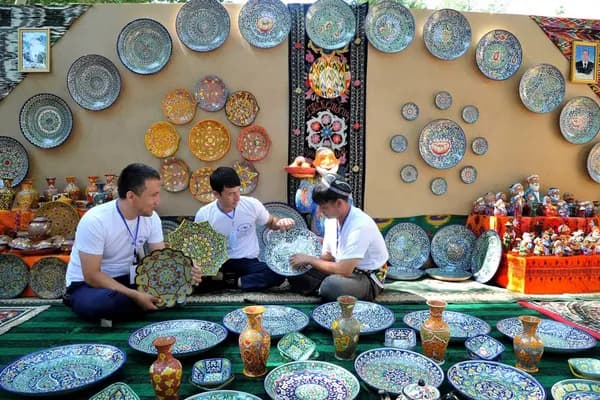
Rishtan pottery is recognisable anywhere: a deep turquoise-blue over white, crazed into a fine web of cracks. The colour comes from a glaze made with ash from a local steppe plant, prepared the traditional way rather than bought in, and the potters here will explain the difference at length if you show any interest at all.
The classic forms are the wide shallow plate for plov and the drinking bowl, decorated with pomegranates, birds, knives and vine. Family workshops are scattered through the town, most with a wheel and a kiln in the courtyard, and most will let you watch. Prices are lower than anywhere else in the country, because you are buying at the source rather than at the end of a chain.
Where the craft is taught
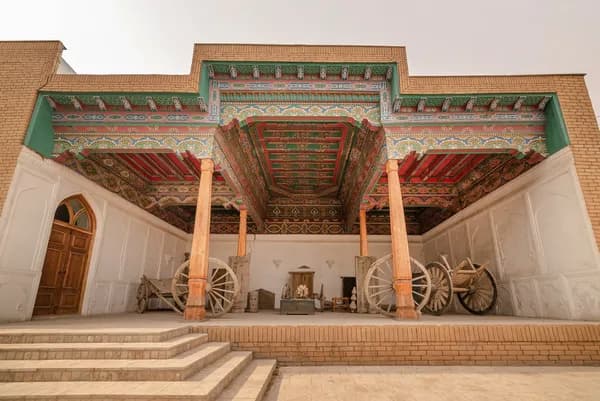
The Said Akhmad-Khoja madrasah in Margilan has been turned into a working craft centre, its old study cells occupied by weavers, embroiderers and instrument makers instead of students. It is the most efficient stop in town: several trades in one courtyard, all of them practising rather than demonstrating.
Both towns run apprenticeships in the traditional way, master to student over years, and both have been recognised for keeping intangible heritage alive. If you want to understand why the crafts survived here and not elsewhere, the answer is in these courtyards rather than in any museum display.
When to go and how it fits
Spring and early autumn are the seasons, as throughout the valley: blossom and mild weather in the first, harvest and clear air in the second. Summer is hot but workable, and the workshops are indoors and cool. Winter is quiet and damp, and the craft continues regardless, which makes it a reasonable time to come if you care about the work rather than the setting.
Both towns sit on the standard Fergana loop out of Tashkent and are usually seen in one day, with Kokand before or after. Allow more time than the itinerary suggests — the whole pull of this place is that you can stay in one workshop as long as you like and nobody will hurry you out.
No payment now. We reply with a tailored plan within a few hours.