
Boysun
A first look
Boysun is a highland district in the far south where an older layer of Central Asian culture has survived more or less intact — songs, rituals, dress, craft and a calendar that predates Islam in places. It was recognised internationally for exactly that, and the recognition is deserved.
It is also spectacular country: red canyons, limestone cliffs, walnut groves and a cave that changed what the world knew about Neanderthals. Very few foreign travellers come here, and the ones who do tend to describe it afterwards as the best part of the trip.
What to see
A district that kept its own culture
Mountains isolate, and Boysun was isolated long enough that practices which faded elsewhere continued here without interruption. The result is a living tradition rather than a revived one: epic songs performed with the doira and the surnay, embroidery with a distinct local vocabulary of motifs, weaving, and seasonal rites tied to the agricultural year.
A festival brings much of it into one place and one week, and it is the easiest way to see the range at once. Outside that, the tradition is spread across villages and households, which means seeing it depends on introductions — the single strongest argument for a local guide anywhere in this country.
Craft here is worth buying rather than only watching. Boysun embroidery uses a distinct palette and a repertoire of motifs that reads quite differently from the suzani of Bukhara or Samarkand, and it is still made for use — for weddings, for dowries, for the house — rather than for sale. What reaches a visitor usually comes through an introduction, and it is priced accordingly, which is to say fairly.
The other thing to seek out is the music. The instruments are the doira, the surnay and the two-stringed dombra, and the repertoire runs from epic narrative to work songs and wedding music. Performances happen in houses and courtyards rather than in venues, so if a guide offers to arrange one, take it — there is no practical way to arrange it yourself.
Zaraut-Say and the painted canyon
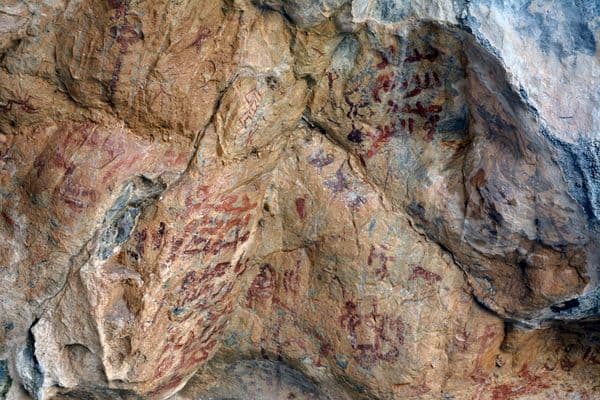
Zaraut-Say is a gorge with rock paintings rather than carvings: ochre figures of hunters and animals on sheltered rock faces, some of them showing scenes that are still argued over by specialists. They are old — Mesolithic and Neolithic — and they are strikingly alive, all movement and gesture.
Reaching them takes a drive on rough road and then a walk, and it is a half day at least. The reward is a canyon almost nobody visits with paintings that would be behind glass and a queue anywhere else in the world.
Teshik-Tash and deep time
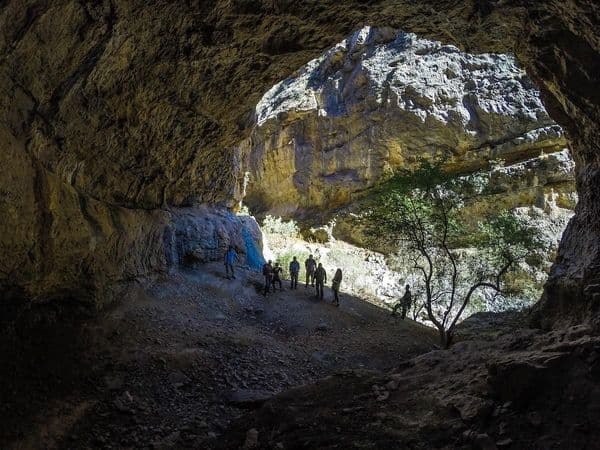
Teshik-Tash is the cave where the burial of a Neanderthal child was excavated, a find that reshaped scientific understanding of the species and its range. The cave itself is a shelter in a cliff at the head of a valley, and there is nothing on display in it — the finds went to Moscow long ago.
What the site offers is location. Standing in the entrance and looking out at the valley the occupants looked at, in a landscape that has changed less than most, does something that a museum case cannot. It is a walk to get there and worth every step for anyone with an interest in prehistory.
Red rock and sacred water
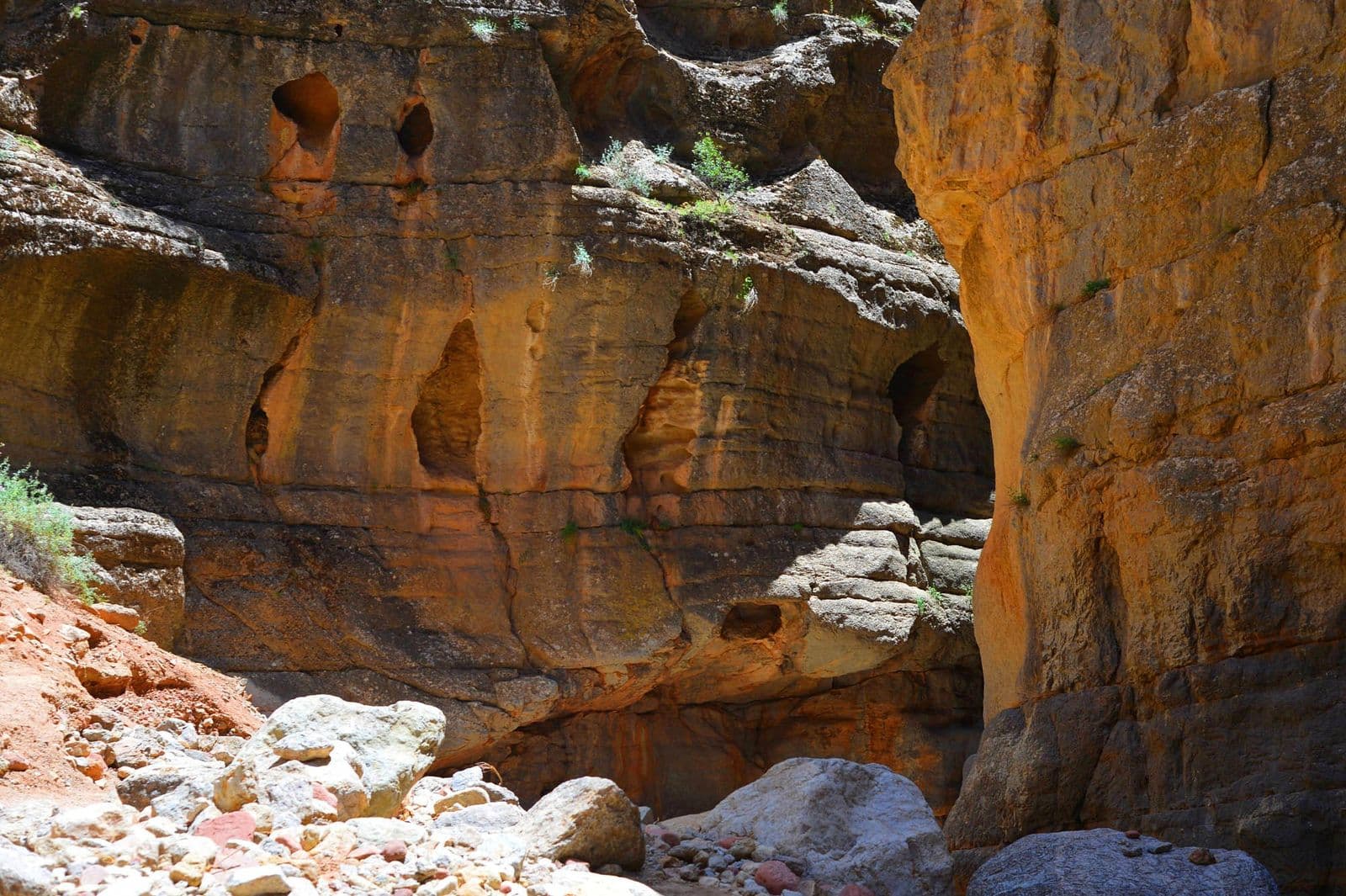
Kyzyl Canyon is the landscape everyone photographs: deep red rock cut into fins, gullies and narrow passages by wind and water, with almost no vegetation to soften it. Walking into the narrow sections in low sun is the thing to do, and it feels considerably further from Uzbekistan than it is.
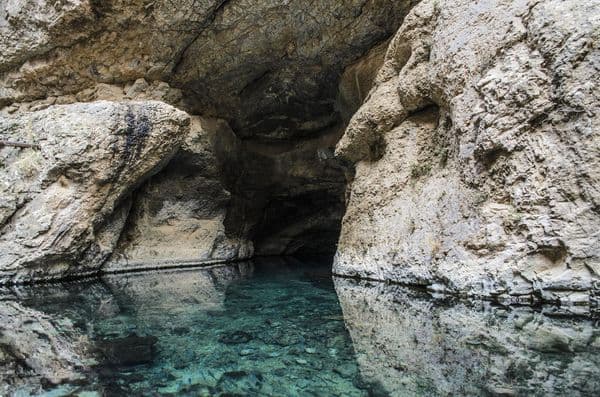
Omonkhona is the counterpoint — a mineral spring in a cliff-walled hollow, regarded as healing and visited as much for that as for the scenery. There is a small settlement around it and people come to drink and bathe. It is a good illustration of how, in this district, the landscape and the belief system are not really separable.
Seasons
Spring is the best of it: green, wildflowers, running water in the canyons, and the festival season. Autumn is the second window, dry and clear, with walnut and fruit harvest in the valleys and comfortable walking weather.
Summer is hot in the low country and manageable in the hills, but the canyons hold heat and the driving is dusty. Winter brings snow to the higher ground and closes some of the roads; the district is not dead in winter, but the rough-road sites become unreliable and should be checked before setting out.
Where it fits in a route
Boysun sits on the road between Karshi and Termez, in the mountains that separate the Kashkadarya region from the far south, and that is exactly how to use it: a stop of a day or two that turns a long transfer into the interesting part of a trip.
It combines naturally with Termez to the south and with Sangardak and Denau to the south-east, and travellers doing the whole southern loop usually string all of these together. Accommodation is simple and mostly in guesthouses, which in this district is an advantage rather than a compromise.
No payment now. We reply with a tailored plan within a few hours.